
ERP Programme Governance: The Difference Between Success and Failure
ERP transformation programmes are among the most complex initiatives organisations undertake.
They involve significant investment, multiple delivery workstreams and major organisational change across finance, operations and technology teams.
Despite careful planning, many ERP programmes struggle to maintain momentum as delivery progresses. Timelines extend, priorities shift and leadership teams can find it increasingly difficult to maintain visibility of programme risk.
In many cases, the difference between successful ERP delivery and programme disruption is not the technology platform or implementation partner — it is the strength of programme governance.
Why Governance Matters in ERP Transformation
ERP programmes operate at the intersection of business transformation and technology delivery.
Finance leaders, operational stakeholders, technology teams and system integrators all play important roles in programme delivery. Without a clear governance structure, however, these groups can easily become misaligned.
Strong governance provides the framework through which organisations maintain control of complex transformation programmes.
It establishes clear ownership of decisions, defines escalation paths and ensures that leadership teams retain visibility of programme health throughout delivery.
The Governance Gaps That Commonly Appear
Many ERP programmes begin with a well-defined governance structure.
However, as delivery progresses and implementation activity intensifies, governance processes can gradually weaken.
Several patterns appear frequently across struggling programmes.
Lack of Clear Decision Ownership
ERP programmes generate a constant stream of design decisions covering areas such as finance processes, reporting structures, integrations and system configuration.
When ownership of these decisions is unclear, programmes can become stalled as stakeholders attempt to reach consensus across multiple teams.
Implementation Partners Acting as Programme Leaders
System integrators play a critical role in delivering ERP systems, but they should not be responsible for defining the organisation’s operating model or transformation objectives.
Where organisations rely too heavily on implementation partners to drive programme direction, the programme can gradually become shaped around system configuration rather than business outcomes.
Inconsistent Programme Reporting
As ERP programmes expand, delivery teams often produce large volumes of status reporting.
However, this reporting does not always provide leadership teams with a clear view of programme health.
Without consistent metrics covering areas such as testing progress, data migration readiness and integration delivery, decision makers may struggle to understand the real risks facing the programme.
Weak Escalation Mechanisms
Complex transformation programmes inevitably encounter delivery challenges.
When governance structures do not include clear escalation mechanisms, issues can remain unresolved for extended periods, increasing delivery risk and slowing programme momentum.
What Effective ERP Programme Governance Looks Like
Successful ERP programmes tend to share several governance characteristics.
Leadership teams establish clear decision-making structures early in the programme and ensure that key stakeholders remain accountable for major programme decisions.
Programme reporting focuses on the health of critical delivery areas rather than simply tracking activity.
Implementation partners are managed as delivery specialists within a governance framework led by the organisation itself.
Most importantly, governance forums remain active and engaged throughout the programme rather than gradually fading as implementation activity increases.
Independent Programme Assurance
As ERP programmes progress, leadership teams can sometimes find it difficult to maintain an objective view of programme health.
Delivery teams may focus primarily on technical progress, while senior stakeholders may receive fragmented reporting from multiple workstreams.
Independent programme assurance can provide a valuable external perspective.
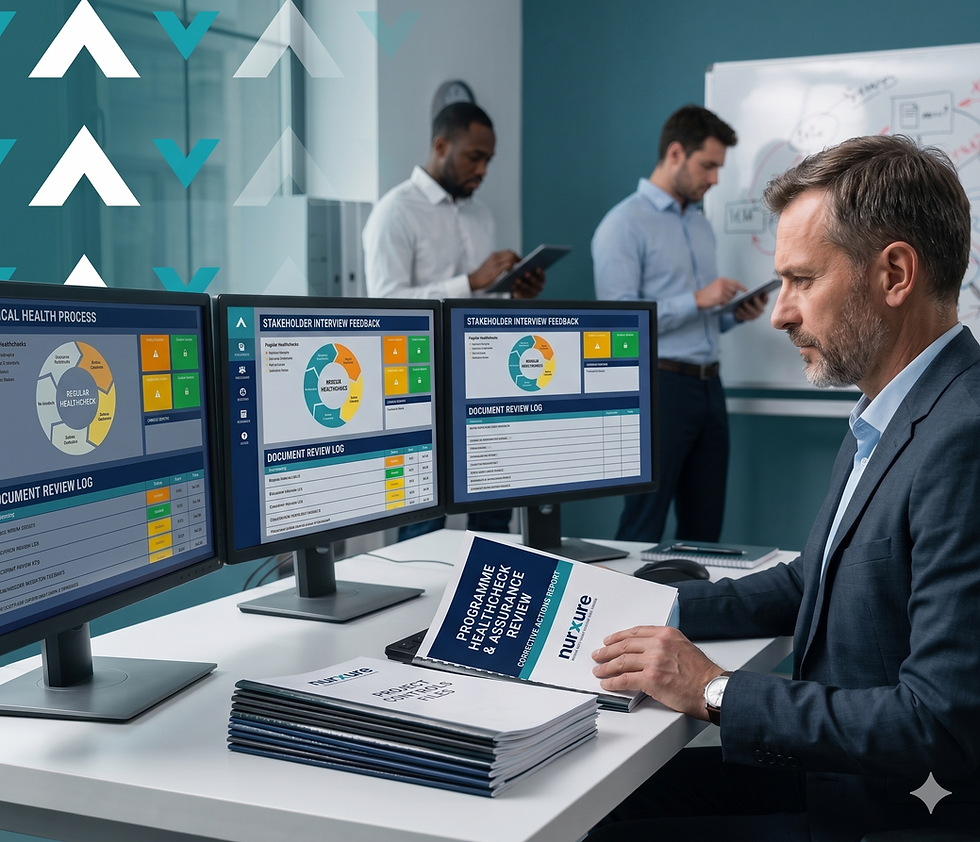
By reviewing programme deliverables, assessing governance structures and speaking directly with key stakeholders, organisations can gain a clear view of delivery risk and identify corrective actions before issues escalate further.
Final Perspective
ERP transformation programmes require more than strong technology delivery.
They require leadership structures capable of managing complexity, aligning stakeholders and maintaining visibility of programme risk throughout the transformation journey.
When governance structures are clear, active and well supported, ERP programmes are far more likely to achieve the outcomes organisations expect.
Comments